The American Linden, or Basswood, (Tilia americana) is a medium- to large-sized deciduous tree native to the North-Central to Northeast U.S. The species grows faster than many North American hardwoods, often twice as fast as the American beech and many birch species. It’s life expectancy is around 200 years, with flowering and seeding occurring between 15 and 100 years, though seed production may start as early as eight years.
Basswood reaches its best development on moist, deep, loamy soils, especially those underlain by limestone, so it is only occasionally encountered in New England forests. It is nitrogen demanding and prefers calcareous soils. It tolerates some drought, but is intolerant of air pollution and urban conditions, per UConn Extension. Like its relative lindens, Basswood is often ringed by numerous sprouts arising from the base of the tree, according to URI’s Guide to New Haven Street Trees.
Basswood creates a wide, domed crown with spreading branches. Bark is green to grayish-green on young trees, becoming dark gray to brown and divided into narrow ridges. Twigs are thicker and stouter than non-native Lindens. Leaves are alternate, simple and heart-shaped, about 7 inches long, toothed and uneven at the base.

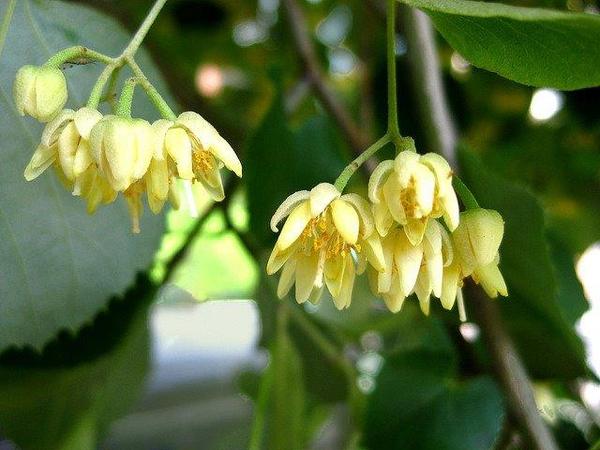
Small, creamy white flowers bloom in late June to early July, with a strong fragrance that makes the trees particularly attractive to honey bees, according to the UConn College of Agriculture, Health and Natural Resources. Sometimes called a “bee-tree,” the regularity of bloom is uncertain because a cold spring day can kill early buds, with sometimes a year or even two passing without flowers, according to Bill Hesbach of the Connecticut Beekeepers Association.
“Each flower can produce enough nectar to send a foraging honeybee back to the colony with a full honey stomach, and there are thousands and thousands of small tulip-shaped flowers making nectar on each tree,” Hesbach wrote. You can also use the leaves to make Linden Flower Tea!
Its leaves are also high in calcium and magnesium, also containing nitrogen, phosphorus and potassium. As leaves break down, these nutrients are added to the soil, improving the quality of soil where it is growing, according to Dave Schroeder of the Eastern Connecticut Forest Landowners Association (ECFLA).
The tree’s soft, fine-grained wood is favored by woodcarvers, while the strong phloem fibers of the inner bark (bast) can be made into rope. Products made from its wood include cabinets, boxes, wooden toys, musical instruments and paper, with many hunting decoys being created using the wood. North Americans soaked the bark in a stream until the non-fibrous material deteriorated, with remaining fibers being twisted together, per the ECFLA.
John Smith reported that native Americans living in Virginia would spin and braid the fibers to make threads that were used for nets, arrow shafts, housing, apparel and fishing gear. Many of these applications continued into colonial America, and are kept alive today in the modern bushcraft and earth skills communities, according to Dana O’Driscoll of the Druids Garden.
Distinctive nutlike fruit hang from long peduncles attached to the persistent leaf-life floral bract. While Basswood is not viewed as an important wildlife tree, the seeds are eaten by several rodents, with twigs browsed by deer and rabbits. Because of its thick, dense crown, the tree is often used as a shade tree. It has few insect or disease problems and grows rapidly on good sites.
The Bucculatrix Improsiva, a golden brown moth, only feeds on the trees in the Tilia species, with the moth creating a yellow cocoon on the underside of leaves before overwintering until spring.
Excellent speciment: 92 Barnett St., Westville.
 East Rock Gazette
Leave a comment