The North American Tulip Tree (Liriodendron tulipifera) has soft, fine-grained wood that is widely used where a cheap, easy-to-work and stable wood is needed. Although sometimes referred to as Tulip Poplar or Yellow Poplar, it is not closely related to true poplars. It’s wood is also called poplar in the U.S. (American tulipwood abroad) but their true species is the family Magnolia. No longer called a hardwood, the term “midwood” was created expressly for the wood of tulip tree.
The tree, along with its close relative the Chinese tulip tree belongs to an ancient lineage dating back 30 to 50 million years ago during a period marked by significant shifts in atmospheric carbon dioxide, according to researchers at Cambridge University Botanic Garden.
Only two of the many species that existed then have survived. But that may be enough of a gift from the earth’s past to help save it. Atmospheric CO2 levels were falling from 1,000 parts per million (ppm) to 500ppm when the trees first evolve, which may have driven the tree’s “midwood” internal structure of the wood to act as a natural carbon sink, capable of absorbing huge amounts of CO2 from the air to be stored in its wood, researchers wrote in September.
“We are now looking at whether its seemingly unique wood structure is the sole reason it is king of carbon capture, and we are widening our search to find out if there are any more midwood trees – or even more new wood types out there,” they wrote.
Habitat
The tree is a major component of the “cove hardwoods” association of Appalachian forests, and is the tallest eastern hardwood species (70-90 ft on avg. with taller trees sometimes even 150 feet or more), and forms a canopy emergent layer above the crowns of adjacent trees. It is a “mid succession” tree from an ecological perspective and is shade intolerant, so it usually comes into dominance 50 to 150 years after a forest regrows.
The species typically exhibits a strong central leader that grows very tall and very straight, with large greenish-yellow, tulip-like flowers borne at the tips of branches in May/June. Because of their soft, weak wood, tulip tree is not recommended as a street tree, but makes an excellent specimen in parks and larger yards, according to URI.
Tulip trees are a well-known host for the large, green eggs of Eastern Tiger Swallowtail Butterflies, which exclusively lay eggs on plants in the magnolia and rose families between July and early August.
Tulip trees prefer rolling hills or mountains with moist, well-drained soil.
Identification:
- On young trees, bark is dark greenish or orange-brown and smooth with small white spots. On older stem, these spots turn ashy gray and divided into long, interlaced mounted ridges.
- Stems are usually only ever about 4-6ft in diameter, but can grow broader if its weak
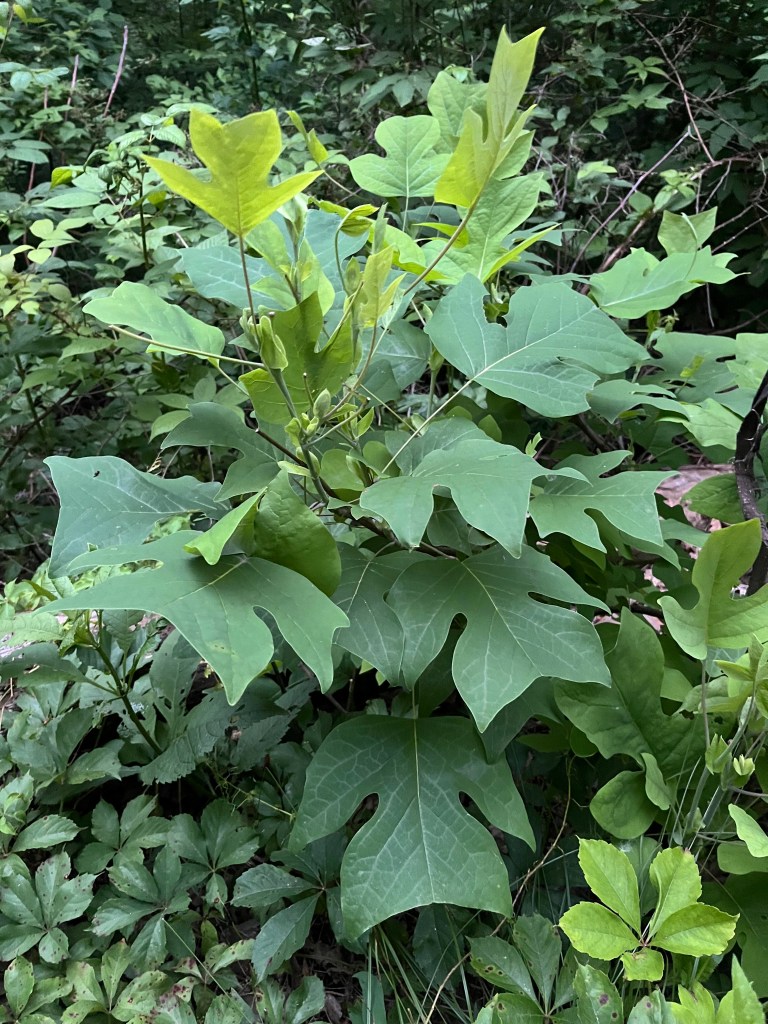
inner bark is able to survive storms. - Leaves are 5-6 inches, alternate, simple, lobed and turn golden-yellow in autumn.
 East Rock Gazette
Leave a comment