A new strain of the already extremely invasive Hydrilla, or water thyme, has emerged in the Connecticut River, threatening the entire country’s water systems if left unchecked.
UPDATE (7/4/2025): A series of social media posts from Connecticut-based rapper Chris Webby highlighting plans to tackle the growing Hydrilla crisis with chemical Diquat Dibromide, a chemical banned in the EU, have led to a sharp spike in complaints from residents.
An online petition circulated by Webby gathered over 15,000 signatures before Friday, with an outpouring of criticism has arisen, including claims of “secret operations” that will “poison Connecticut lakes” to “enrich scientists or agencies”. Officials have acknowledged the use of diquat, but said it is being done in compliance with state and federal regulations following lengthy studies along the Connecticut River, the CT Mirror reported.
“Scientists from the Connecticut Agricultural Experiment Station’s Office of Aquatic Invasive Species, want to address some of the misleading and inaccurate claims circulating about the herbicide treatment efforts in the Connecticut River. These efforts are not reckless, profit driven, or environmentally destructive,” scientists from the Connecticut Agricultural Experiment Station’s Office of Aquatic Invasive Species said in a statement.
“Rather, they are grounded in years of rigorous research, planning, and coordination across local, state, and federal levels, with oversight from agencies like the U.S. Army Corps of Engineers and the EPA. Portraying this as mass poisoning or chemical dumping reflects a fundamental misunderstanding of both the scale and methodology of what is actually happening,” the CAES office said.
Hydrilla is a submersed aquatic plant that grows rooted in sediment and can travel as a free-floating plant when fragmented, spreading to new areas it lands, according to a fact sheet by UConn Extension. Hydrilla forms dense mats of vegetation that quickly outcompete native species for habitat, while making waterways difficult to navigate for boats and aquatic species.
Slender stems reach from the sediment to the surface of the waterbody and can grow over seven meters. At the water’s surface, stems are highly branched, forming dense mats of vegetation, per the fact sheet.
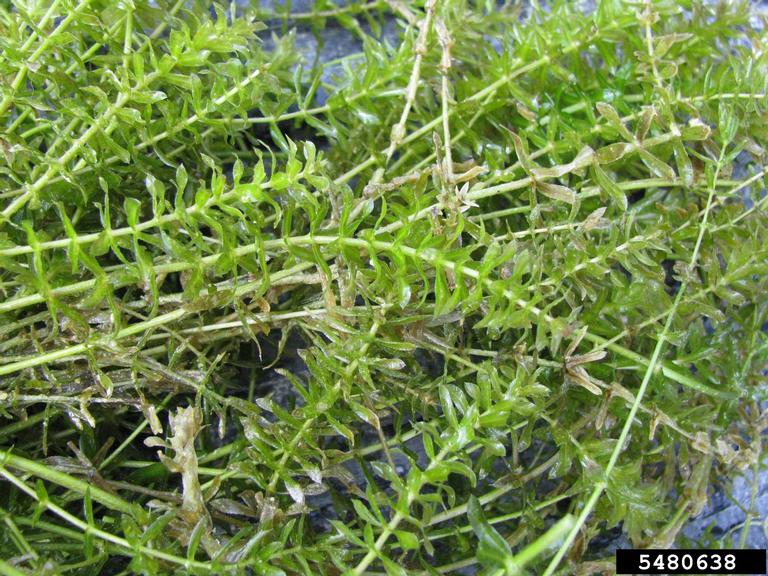
While some Hydrilla species do seldom produce seeds, the plant is mainly spread by vegetative propagules, including tubers, turions and stem fragments, according to Jeremiah R. Foley, Ph.D., assistant scientist at the Office of Aquatic Invasive Species (OAIS), which is part of the Department of Environmental Science and Forestry at the Connecticut Agriculture Experiment Station (CAES).
Known as one of the most noxious aquatic invasive plants, it grows extremely fast — said to grow up to 191 inches in a day — and is adaptable to many environments, Foley said. Before you pass out, that figure refers to the total growth of the entire plant, meaning that if a plant has 191 tips, each can grow an inch per day.
“It has amazing photosynthetic machinery, where it can switch from bicarbonate use to carbon dioxide use, and at the end of the year when all of these plants die, it demands oxygen which causes severe fish kill offs,” Foley said April 1 during a presentation, “Ripple of Invasion: Understanding the Spread and Impact of Connecticut River Hydrilla”, as part of the Connecticut Agriculture Experiment Station’s 2024-2025 Seminar Series.
“But then you don’t see the fish, because they get caught in the hydrilla. It stagnates the water, which then increases the mosquitos for disease breeding grounds. The list goes on and on,” Foley said. Hydrilla can also compromise tourism, diminish waterfront property values and create economic losses, with the U.S. Army Corps of Engineers, which is assisting Foley and others across the state to protect waterways, calling it “a water infrastructure threat” in a May 2023 executive summary on the novel Connecticut River subspecies invasion.
Two main strains of Hydrilla have historically been identified in the United States — dioecious Hydrilla in the South and monoecious Hydrilla in the North — both wreaking havoc on waterways from Florida to New England. After escaping from a haphazard aquarium owner in the 1980s, the estimated economic cost of the invasive species quickly reached $2 billion in the 1990s. That figure has since ballooned to over $21 billion in the 2020s.
Connecticut Hydrilla
In 2016, a new subspecies of Hydrilla (H. verticillata ssp. lithuanica), or Northern Hydrilla, was discovered in the Connecticut River. By 2021, the novel threat was found in more than 113 kilometers of river, occupying approximately 850 acres, according to peer-reviewed research published last year in Invasive Plant Science and Management. The Connecticut Hydrilla species has since expanded outside of the river, impacting five waterbodies in Connecticut and another in Massachusetts.
Except for one site, all locations infested with this novel subspecies provide watercraft access through public or private boat ramps. “Significantly, three of these sites are well regarded for their fishing opportunities,” and are frequented by anglers from the Connecticut River, the researchers, including Foley, wrote in the paper.
“You have these fishing competitions … to get from this water body to that water body the fastest. And to get up and out of the water, and to do it as quickly as possible is only advantageous for you to win … so that incentivizes the movement of these plants,” Foley said. This responsibility largely falls on individual anglers as “tournaments are well regulated by DEEP and participants are often knowledgeable about aquatic invasive species issues,” he noted.
In 2024, the state discovered the new Northern Hydrilla species in four more locations, bringing the total to 10 and raising further alarm. “If you know anything about biological invasions, there’s a point where it exponentially takes off. Where it’s like the cat’s out of the bag, and we’ve got a problem here. We think we’re there with Connecticut River Hydrilla and detecting it at all these new places,” Foley said.
The current measures
At the moment, public outreach and ensuring boaters are cleaning and drying their boats is the main lever the state has been pulling to stop the spread of Connecticut River Hydrilla. “Ultimately it’s just this adage of ‘clean, drain, dry your boat,” Foley said.
Boatwashing stations are increasingly being used in parts of the U.S. to battle aquatic invasive species, which boaters can unknowingly carry on their vessel and spread in additional bodies office water. In response, Connecticut’s Environment Committee is considering legislation that would create a pilot program for boatwashing stations at a key Salem body of water (Gardner Lake), said State Senator Martha Marx (D-New London) and State Representative Nick Menapace (D-East Lyme, Montville, Salem) in early March.
The pilot program is intended to build upon existing systems in place across the state educating the public about aquatic invasive species and how to approach plant removal, which can be a “costly, time-consuming and repetitive process,” per Marx’s release.
Connecticut boating statutes already emphasize the “clean, drain, dry” technique, where boaters should inspect and clean their vessels, drain water from every part, and let them dry before going out again, for up to five days if possible. The new washing station proposal would provide an on-premises way for boaters to quickly achieve that goal without damage to a boat, its components or its equipment, Marx says.
Current state practices emphasize education and prevention to protect state waterways. Existing policies include a $100 violation for anyone caught transporting a vessel without inspecting and cleaning it and an Aquatic Invasive Species Stamp, funded by vessel registration or renewal and by out-of-state boaters. That stamp funds projects including increased awareness, restoration and rehabilitation of bodies of water and treatments to control aquatic invasive species, .
In addition, the U.S. Army Corps of Engineers is working to monitor and map invasion of Connecticut River Hydrilla, perform genetic research, develop management approach research and testing and to draft a 5-year management plan.
Hopeful solutions
Biological control methods, which introduce natural predators to invasive plant, have largely been ineffective in combating existing Hydrilla in the southern U.S., but Foley believes there may be cause for hope in the strategy for the Connecticut River subspecies.
A species of fly he is researching, which the U.S. Army Corps of Engineers has already bred and released by the millions in the south, are actually native to the same region as the Connecticut River species. “So from a physiological standpoint, the flies are probably going to be able to over winter here, which is probably the first hurdle coming from South Florida,” Foley said.
The water is also too hot in Florida for flies to survive landing on it, so they have to wait until plants grow to crack the surface. Even then, once plants have fully topped out and formed dense surface mats, the temperatures within those mats can skyrocket to levels that are no longer suitable for larval development, he said.
Recent research also shows the flies may be able to over winter on turions, or portions of the plant off the plant and spread the plant. “By the time they wake up, the flies are already established and already have a foothold on that turion. So as the plant elongates and grows, so does the population of the flies.
“I’m hoping that the flies can over winter on turions, so they would get a foothold a lot sooner than would otherwise occur if they had waited for plants to land on.”
CAES has finished sorting out rearing procedures and is starting to begin choice testing to see what strain prefers Connecticut River Hydrilla, according to Foley.
“This is at the cutting edge. We’re really excited to see where this is going and hope to make releases, if all goes well, within the next year or two,” he said.
 East Rock Gazette
Leave a comment